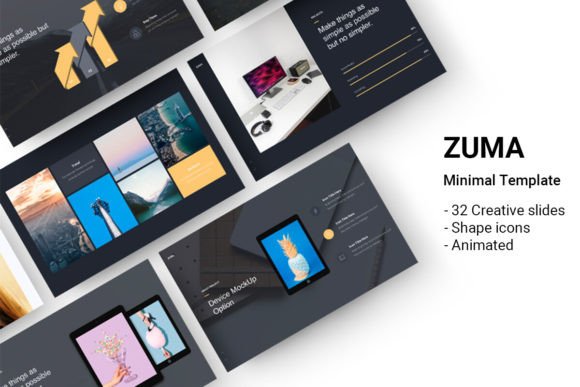
ZUMA Powerpoint Minimal Template: A Complete Tool for Modern Presentations
Creating a presentation that holds attention, communicates clearly, and looks professionally polished is no small task. Many presenters find themselves spending more time adjusting layouts, aligning shapes, and hunting for the right icon than refining their actual message. The ZUMA - Powerpoint Minimal Template aims to change that dynamic entirely. Rather than offering a rigid set of slides, it provides a flexible ecosystem where design decisions are largely made for you, so you can focus on content. Whether you are building a corporate pitch, a creative portfolio, or a detailed infographic report, understanding the full scope of what ZUMA offers can help you decide if it fits your workflow.
This article explores the template’s main features, how it supports modern presentation needs, and what practical benefits you can expect when using it. We will look at everything from its responsive 16:9 canvas to the included video tutorial, all while keeping an eye on what matters most: delivering a compelling presentation without unnecessary friction.
What Makes ZUMA Different: Core Functional Highlights
At first glance, many presentation templates look similar. The difference lies in how they handle real-world use cases. ZUMA is built on a full screen responsive 16:9 wide format, which means your slides will look crisp on laptops, projectors, and even large monitors without awkward black bars or stretched visuals. This ratio has become the standard for modern displays, and ZUMA embraces it fully, ensuring your content fills the screen edge to edge.
Beyond the canvas, the template relies on vector shapes for all graphical elements. Vectors scale infinitely without losing quality, so whether you are presenting on a 13-inch laptop or a 75-inch screen, every line, icon, and diagram remains sharp. This is especially important when you are working with detailed charts or intricate infographics — pixelation becomes a non-issue.
The master slide option is another cornerstone of ZUMA’s efficiency. Instead of manually updating each slide when you need to change a font, color, or footer, you can edit the master slide and have those changes propagate across your entire deck. This is a time-saver that experienced presenters rely on heavily. It also ensures consistency, which is critical when presenting to clients or stakeholders who notice visual coherence.
Precision Through Drag and Drop and Image Replace
One of the most practical features in ZUMA is the easy editable drag and drop functionality paired with image replace. Rather than wrestling with placeholder boxes or hunting for the right menu, you simply click and drag to reposition elements, or right-click to swap out placeholder images with your own. This reduces the friction of slide creation dramatically. For example, a team working on a project portfolio can drag in screenshots and drop them into predefined frames in seconds.
Image replace goes a step further: you do not need to worry about cropping or resizing manually. The template automatically fits your new image into the existing frame, maintaining proportions and alignment. This is especially useful for designers and non-designers alike, as it removes the guesswork from visual consistency.
How ZUMA Integrates Into Modern Presentation Workflows
The way people build presentations has evolved. Gone are the days when a single person spent hours tweaking every slide. Modern workflows often involve teams, quick turnarounds, and multiple revisions. ZUMA is designed to support this kind of environment through its ready to use colour template system. You can select a color palette that aligns with your brand or project theme, and every element — from backgrounds to shapes to text — will adhere to that palette automatically. This eliminates the need to manually update dozens of individual elements when a client suddenly wants a new brand color.
For agencies and freelancers, this feature alone can cut presentation prep time by more than half. Imagine you have a pitch meeting in two hours and the client just sent their updated brand guidelines. With ZUMA, you adjust the color template once, and your entire deck reflects the change instantly. That is the kind of practical efficiency that separates a good template from a great one.
Another workflow consideration is how the template handles font management. ZUMA includes an Unlimited Font Icon Library v3 and a Font Collection that gives you access to a wide range of typographic styles. Having unlimited icons means you never have to search for a separate icon set or worry about licensing restrictions. Every icon you need for portfolio work, team slides, infographics, or charts is already embedded and ready to use. You simply drag the icon you want, resize it, and recolor it to match your palette.
Typography That Works Hard for You
The font collection in ZUMA is worth highlighting because typography is often the most overlooked aspect of presentations. Using the wrong font can make a professional deck look amateurish. ZUMA provides a curated set of typefaces that pair well together, covering headings, body text, callouts, and captions. This removes the guesswork of font pairing, which is a common struggle for non-designers. You can trust that the included fonts will look cohesive and readable across all slides.
Practical Applications: Portfolio, Team Work, Infographics, and Charts
Now let us get specific about how ZUMA performs in real scenarios. The template includes all essential functions for building portfolios, team presentations, infographics, and charts. But rather than just listing these features, it helps to understand how they work together in practice.
Suppose you are a creative professional putting together an online portfolio in PowerPoint format. You need to showcase multiple projects, each with images, descriptions, and key metrics. ZUMA provides pre-built portfolio slides where you can drop in your work, add text, and even include small data points using the built-in chart tools. The vector shapes ensure that your images and icons stay crisp, while the master slide keeps your name and contact info consistent across every page.
For team-based presentations — say a quarterly review or a project kickoff — ZUMA offers dedicated slides for team member introductions, role breakdowns, and collaborative timelines. You can use the easy editable drag and drop to arrange team photos and bios quickly. The infographic and chart capabilities then allow you to present data like budget allocation, progress milestones, or performance metrics without needing a separate tool like Excel or Illustrator. Everything lives within PowerPoint, and everything looks cohesive.
Infographics That Tell a Story
Infographics are one of the most powerful ways to communicate complex information quickly. ZUMA includes a range of infographic layouts — from timelines and flowcharts to comparison tables and data visualizations. Because all elements are vector based, you can scale and rearrange them without quality loss. The unlimited icon library means you can add visual cues that help viewers process information faster. For example, a health industry presentation could use medical icons alongside stat boxes to make data more digestible.
Charts in ZUMA are not an afterthought. They are designed to match the template’s minimal aesthetic, with clean lines and subtle color variations. You can edit data directly within PowerPoint’s chart editor, and the template’s styling will automatically apply. This integration is seamless and reduces the need for external charting software.
Making the Most of the Unlimited Font Icon Library and Font Collection
One of the standout value points of ZUMA is the Unlimited Font Icon Library v3. In many templates, icons are either limited in number or fixed in style. ZUMA gives you access to a library that covers virtually every category you might need: technology, business, education, health, travel, finance, and more. Since it is font based, you can change the color and size instantly without degrading quality. This is a huge advantage when you need to create a consistent visual language across your slides.
The Font Collection works hand in hand with the icon library. You get not just one or two typefaces but a full set that includes sans serif, serif, and display options. This allows you to establish a clear hierarchy in your text — bold headings, readable body copy, and accent styles for quotes or statistics. When combined, the icons and fonts give you a toolkit that can produce anything from a minimalist startup pitch to a detailed academic poster.
Learning and Support: Documentation and Video Tutorial
Even the most feature-rich template is only as good as your ability to use it effectively. ZUMA addresses this with a full documentation PDF online and a video tutorial. The documentation walks you through every feature, from setting up the master slide to replacing images and adjusting color templates. It is written in plain language and includes screenshots where helpful.
The video tutorial is especially useful for visual learners. Instead of reading through steps, you can watch someone navigate the template in real time. This is incredibly helpful for understanding things like drag and drop nuances, icon insertion, and chart editing. For teams, having a video guide means you can onboard new members quickly without repeated one-on-one training sessions.
Both resources are available online, so you can access them from anywhere. This is particularly valuable for remote teams or freelancers who work across different devices and locations.
Factors to Consider Before Choosing a Presentation Template
When evaluating any template — including ZUMA — there are practical factors worth thinking about. First, consider the level of customization you actually need. ZUMA offers a wide range of flexibility, but if your presentations are extremely specific or require non-standard layouts, you may still need to do some manual adjustments. That said, the master slide option and drag and drop features handle most common needs.
Second, think about compatibility. ZUMA is built for PowerPoint, and while it works across multiple versions, you should ensure your software supports the features you plan to use, especially the font icon library and vector shapes. The documentation clarifies version requirements, so check that before committing.
Third, consider the learning curve. Even with excellent documentation and video tutorials, if you are completely new to PowerPoint, there may be a short adjustment period. However, ZUMA is designed to be intuitive, and most users find they can produce a polished deck within their first session.
Finally, think about brand consistency. If you frequently present to the same audience, having a template that allows quick color and font changes is essential. ZUMA’s ready to use colour template and font collection make it easy to maintain a consistent brand image across multiple presentations.
Who Benefits Most from ZUMA
This template is an excellent fit for professionals who need to produce clean, modern presentations regularly. Marketing consultants, project managers, creative directors, educators, and startup founders will all find it useful. It is also a strong choice for agencies that need to deliver client presentations quickly without sacrificing design quality. The combination of vector graphics, unlimited icons, and responsive layout makes it a versatile tool that adapts to different industries and use cases.
At the same time, individual users who only present occasionally will appreciate how much time ZUMA saves. Instead of spending hours designing from scratch, you can focus on writing clear, persuasive content and let the template handle the visual heavy lifting.
Final Thoughts on ZUMA as a Presentation Tool
The ZUMA - Powerpoint Minimal Template brings together all the essential features that modern presenters need in one cohesive package. From its responsive 16:9 canvas and vector shapes to its drag and drop simplicity and rich icon library, every element is designed to reduce friction and elevate the final output. The inclusion of master slide options, color templates, and dedicated portfolio, team, infographic, and chart slides means you rarely need to look elsewhere for a specific layout.
Whether you are preparing a boardroom pitch, a conference talk, or a client update, ZUMA gives you the structure to present confidently and clearly. The supporting documentation and video tutorial remove the guesswork, making it accessible even for those with limited design experience. If you value efficiency, consistency, and professional aesthetics in your presentations, ZUMA is a template worth exploring.