Rucodara - PowerPoint Template: A Practical Guide for Professional Presentations
Putting together a presentation that resonates with an audience often takes more effort than the content itself deserves. You might have the data, the story, and the insights, but without a visual structure that guides attention and reinforces your message, those elements can get lost. Rucodara is a PowerPoint template designed to bridge that gap—giving you a foundation that turns slides from mere information holders into narrative tools. It belongs in the hands of anyone who prepares presentations regularly, whether for client pitches, internal reports, educational sessions, or creative showcases.
This article explores what Rucodara brings to the table, where it fits in a real-world presentation workflow, and how you can integrate it smoothly into your own process. The focus is on practical use—not just what the template includes, but how you can leverage those features to save time, maintain consistency, and deliver stronger presentations.
How Rucodara Fits into Your Presentation Workflow
Every presentation follows a basic arc: planning, content development, design, refinement, and delivery. Rucodara sits squarely in the design and refinement stages, but its influence reaches both earlier and later. By providing a cohesive visual system upfront, it reduces the number of decisions you need to make during content creation. You don’t have to wonder about color schemes, slide layouts, or graphic styles while you’re still shaping your message. That mental bandwidth can stay focused on the substance of your talk.
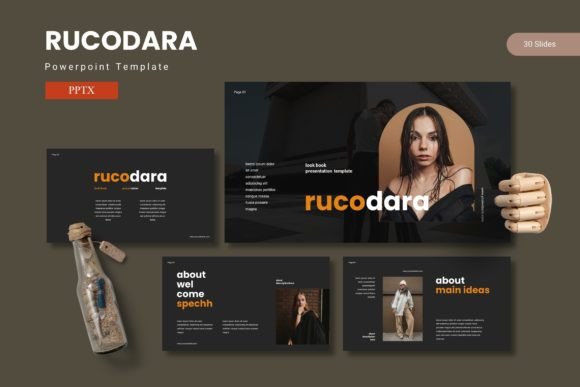
Before you open PowerPoint, it helps to know what kind of slides you’ll need. Rucodara comes with 150 total slides across five premade color variations, each theme containing 30 slides. That means you can roughly map out your content structure and know exactly which layout types are available: section breaks, infographic-heavy slides, gallery and portfolio pages, and standard content slides. If your presentation requires a mix of data visualization, image-heavy spreads, and text-driven arguments, you already have a matching container for each section.
During the creation phase, the template works as a flexible starting point. Because every graphic element is resizable and editable, you’re not locked into rigid placeholders. You can adapt the infographics to reflect your own data, swap out icons, or adjust proportions without breaking the visual consistency. The pixel-perfect illustrations maintain clarity even when resized, which is especially useful when you need to project on a large screen or export slides as images for social media.
After the presentation is built, Rucodara continues to serve you. Since it’s based on master slides, any global change—like switching the color scheme or updating a recurring element—can be done in a few clicks without manually editing each slide. This is a huge time saver when you need to produce multiple versions of the same deck for different clients or departments. It also ensures that your final output looks deliberate and polished, not like a collection of mismatched slides.
Key Features That Streamline Your Process
Let’s look at the specific features that make Rucodara a practical tool for professionals, creators, and entrepreneurs. Understanding these elements helps you decide how to use them before you even start designing.
- 150 total slides, 5 premade colors: Instead of starting from a blank slate every time, you pick a color family that matches your brand or mood. Each color variation includes all 30 slide types, so consistency is baked in from the start. If your presentation requires a softer tone, choose one palette; for a high-energy pitch, another. The flexibility lets you adapt without rebuilding.
- Section break slides: These are often overlooked, but they are critical for pacing. A good section break slide signals a shift in topic and gives the audience a mental reset. Rucodara includes them across all color themes, so your presentation’s structure feels intentional.
- Handcrafted infographics based on master slides: The infographics are not just decorative—they are built on master slides, meaning you can update data points globally. If you reuse a chart template across multiple presentations, you only need to change the numbers, not the design. This is a major efficiency gain for recurring reports or quarterly reviews.
- Pixel-perfect illustrations, all resizable and editable: Vectors within PowerPoint are rare but valuable. You can scale illustrations up or down without losing quality, and because they are editable, you can recolor them to match your palette. No need to export graphics from other tools—everything lives inside the template.
- Picture placeholders with drag-and-drop: No more cropping or positioning images manually. Drop your photo into the placeholder, and it automatically fits the intended frame. This feature is especially useful when you’re working with a team and need to hand off a deck without lengthy instructions.
- Gallery and portfolio slides: If you’re showcasing work—whether it’s design projects, product photos, or event highlights—these slides give you a structured layout without making your images feel cramped. They work well for creative professionals and small business owners who need to present a portfolio as part of a pitch.
These features are not isolated; they work together. For example, you might choose a color theme, then use the master slides to apply that theme across all infographics. You then drag your images into the portfolio layouts, and the consistent color scheme ensures the gallery feels like part of the whole deck rather than an afterthought.
Practical Implementation Tips for Maximum Efficiency
Owning a template doesn’t automatically make your presentations better—it’s how you use it that counts. Here are concrete ways to integrate Rucodara into your routine without friction.
- Start with the Read Me First file. That folder contains font information, photo credits, and a quick setup guide. Before you even open the PPTX file, install the recommended fonts. This prevents formatting shifts when you present on someone else’s machine. The Read Me also lists the color hex values, which you can use to match other brand materials.
- Decide your color scheme early. Open the template, look at the five variations, and pick the one that aligns with your project. If none are perfect, you can adjust because the colors are editable. But committing to a base scheme early prevents endless tinkering later.
- Use master slide editing for global updates. If you need to add your company logo to every slide, do it on the master slide. If you want a different background texture, change it once. This is where the template’s architecture saves hours. Master slide editing is often underused, but it’s the most efficient way to maintain consistency across a large deck.
- Adapt infographics to your data. Don’t treat the provided infographics as final. Right-click to edit data, or ungroup elements to customize them further. The handcrafted nature means they are designed to be modified, not just dropped in as static images. Take advantage of that flexibility to make your data stand out.
- Use picture placeholders systematically. When you import images, name your files clearly before dragging them in. This helps if you ever need to replace images later—you’ll know exactly which slide uses which photo. For team collaborations, this practice prevents confusion.
- Keep a version log. Since you might use the same template for different projects, save each deck separately with a clear naming convention (e.g., “ClientName_Date_ThemeColor”). This makes it easy to reuse slides from past projects without recreating them.
These steps may seem simple, but they create a repeatable process. Once you’ve set up your preferred color variation, fonts, and master edits once, every subsequent presentation built from Rucodara becomes faster and more consistent.
Integrating Rucodara with Other Tools and Assets
No presentation exists in a vacuum. You’re likely pulling data from spreadsheets, collecting images from photo libraries, sharing slides through cloud platforms, and perhaps collaborating with colleagues. Rucodara interacts well with these external elements when you plan for it.
For data-heavy presentations, prepare your charts and figures in Excel or Google Sheets ahead of time. Then paste them into the infographic slides. Since the template’s graphics are built on master slides, you can often replace placeholder charts with live data links if you prefer. This keeps your numbers current until the moment you present.
If you work with brand guidelines, extract the exact color codes from your brand kit and apply them to the template’s color scheme. The five premade colors are a good starting point, but you can edit any element to match corporate standards. Similarly, the font information in the Read Me file helps you align with your organization’s typography. If the recommended fonts conflict with your brand, swap them—the layouts are designed to work with clean, readable fonts.
For collaborative teams, use Microsoft 365’s co-authoring feature. Because Rucodara is a standard PPTX file, multiple people can work on different sections simultaneously. The master slide structure ensures that even if everyone adds their own content, the visual theme stays unified. Assign each team member a set of slides (e.g., section break slides, infographics, portfolio pages) and merge them into one deck at the end.
When exporting, remember that Rucodara’s pixel-perfect illustrations and high-resolution placeholders hold up well in PDF or video formats. If you need to create a handout or a recorded version, the quality remains professional.
Long-Term Use and Consistency
The real value of a template like Rucodara emerges over time, not just in a single project. If you produce presentations regularly—whether for weekly team updates, monthly newsletters, or quarterly business reviews—reusing a consistent visual system builds recognition and trust with your audience. They begin to associate that clean, structured look with your work.
One practical approach is to create a set of “starter decks” based on Rucodara. For example, make a template for internal reports using one color scheme, and a separate template for client pitches using another. Keep the master slides identical in structure but different in color. This way, you have two distinct presets that are still based on the same underlying design language.
Over a year of regular use, you’ll find that slide creation becomes a matter of content placement rather than design exploration. The drag-and-drop picture placeholders, editable infographics, and section break layouts become second nature. You spend less time worrying about alignment and more time refining your story.
Quality control is also easier with a locked template. When multiple people work on presentations, the chance of someone accidentally using a wrong font or off-brand color decreases. The master slide system enforces consistency even for less design-savvy team members.
Who Benefits Most from This Template
Rucodara suits a wide range of users, but certain profiles will get the most out of it. Marketing professionals and entrepreneurs who pitch to clients regularly will appreciate the portfolio and gallery slides. Educators and trainers can use the section breaks and infographic layouts to break down complex topics into digestible visual chunks. Freelancers and small business owners who handle their own decks can jump straight into content creation without needing a design background.
Even if you’re a hobbyist or a blogger creating slide decks for online courses or YouTube videos, the sheer volume of slides—150 per color theme—means you never run out of layout options for different types of content. The template respects the time you invest by making customization straightforward.
The bottom line: Rucodara is not a magic bullet that writes your presentation for you. It is a well-structured tool that removes friction from the design process, letting you focus on the substance and delivery of your message. When you integrate it thoughtfully into your workflow, you gain speed, consistency, and a professional result every time.